If you’re trying to figure out how to compare dental AI vendors, you’ve probably already hit the wall: sit through three demos in a week and you stop being able to tell them apart. Every vendor answers calls 24/7. Every vendor books appointments. Every vendor shows you a clean call that ends in a happy patient. By the third demo, your notes are interchangeable, and the decision quietly defaults to whoever had the smoothest rep or the lowest quote.
That’s not a buyer failing. It’s a category problem. The surface-level capabilities really are identical — and the real differences between systems never come up on a sales call, because no vendor volunteers their weak spots. So here is the set of questions that pull those differences back into the light, and how to compare dental AI vendors on what actually separates them.
1. “Show me what happens when the call goes wrong”
Any system can book a Tuesday cleaning for a calm caller. The separation happens on the hard calls: the patient describing a real emergency, the caller who interrupts and changes topic, the person asking for something the system shouldn’t give. Ask the vendor to show you those calls — not a slide describing them, an actual call.
If they can’t, that tells you the system has been demoed but not stress-tested. This is exactly the gap an independent evaluation closes: testing the system on emergencies, adversarial callers, and insurance edge cases instead of the golden path. A vendor confident in their AI receptionist welcomes that scrutiny. A vendor selling polish changes the subject.
2. “Did the appointment actually land in my PMS — or did the bot just say so?”
There is a meaningful difference between an AI that says it booked an appointment and an AI that wrote the appointment into your practice management system. Plenty of systems narrate an action they didn’t reliably complete. The gap shows up later as an empty chair nobody scheduled and a patient who’s sure they had an appointment.
Ask precisely how bookings are written, to which PMS, and how failures are surfaced. A serious system writes appointments directly into the PMS and verifies the result. A demo-grade system produces a confident voice and a hopeful API call.
3. “What does it do with my data — and whose models does it train?”
This question separates infrastructure from wrappers fast. Some tools are thin layers over a shared model, which means your patient data may be pooled in ways you’d never agree to if it were stated plainly. Ask whether your data is isolated, whether it’s ever used to train models serving other dental organizations, and where it physically lives.
The answer you want is unambiguous: your data is siloed, encrypted, never used to train models for other organizations, and you control access by role. If the vendor gets vague here, you’ve learned something the demo wouldn’t have told you.
4. “Is this one system, or ten tools wearing a trench coat?”
Many “platforms” are a booking widget, a texting tool, and a forms app stitched together — separate logins, separate data, no shared intelligence. The tell is whether the system can connect events across functions: does a missed call become a follow-up task? Does an unscheduled treatment plan surface as a recall opportunity? Does the schedule know the patient’s outstanding balance?
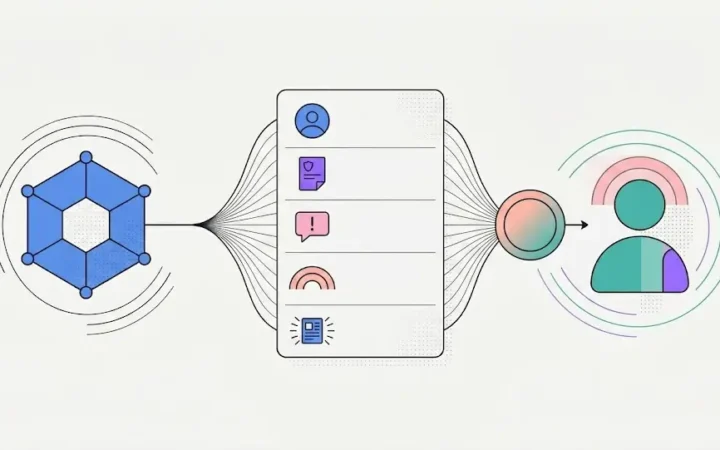
A genuinely unified system shares one source of data across reception, scheduling, insurance, and clinical notes, so it can act on connections a bundle of point solutions can’t see. This is the single biggest differentiator hiding behind the sameness — and it comes down to whether there’s one shared intelligence underneath, or just one invoice on top. The strongest systems are built around a central brain that every function runs on, more like an operating system for the practice than a folder of apps; that architecture is what lets a missed call become a follow-up task or an unscheduled treatment surface as a recall, automatically. This is one of the clearest ways to compare dental AI vendors: ask to see a workflow that crosses three functions, and watch whether it’s seamless or whether they switch tabs. (It’s the whole idea behind a unified system versus stitched-together point tools, and worth understanding before you compare anyone.)
5. “How does it get better — and can I see that it does?”
Ask what happens after the system makes a mistake on a call. Does anyone find out? Does it correct? Can you see evidence of improvement over time, or are you taking it on faith? The best systems have an explicit self-correction loop and can show you a trend, not just a testimonial.
Better still, ask whether the vendor will let their system be measured by something they don’t control — an independent, inspectable evaluation. The willingness to be graded by a yardstick the vendor didn’t write is, by itself, one of the most honest signals you’ll get in the entire buying process.
The question underneath all five
Every one of these reduces to a single test: will this vendor show me evidence, or only assurances? Every vendor will assure you they handle emergencies, protect data, and book reliably. The ones worth buying can prove it — on the hard calls, against an independent standard, with their data practices stated plainly. The category sounds identical because assurances are cheap. Evidence is what separates the systems, and evidence is exactly what a good demo is designed to avoid.
This matters most when you’re standardizing across many locations, where one wrong call multiplies; it’s worth comparing vendors with the same rigor you’d apply to any infrastructure decision for a DSO or group practice. ELVA’s own position is that evidence should be the default, which is why there’s an open-source way to test dental AI — including ELVA’s own system. But whichever vendor you choose, ask the five questions. The right system will be glad you did.
Frequently Asked Questions
How do you compare dental AI vendors that all sound the same?
Look past the surface capabilities (24/7 answering, booking) to five differences demos hide: how the system handles calls that go wrong, whether bookings are verified in the PMS, how your data is handled and whether it trains other organizations’ models, whether it’s a unified system or stitched-together tools, and whether it improves measurably. These are where vendors actually differ.
What’s the single best question to ask a dental AI vendor?
“Will you show me evidence, not just assurances?” Concretely: show me a call that went wrong, prove the appointment landed in my PMS, and let the system be measured by an independent standard you didn’t write. Vendors with strong products welcome this; vendors selling polish deflect.
How do I verify a dental AI actually books into my PMS?
Ask exactly how and to which PMS appointments are written, and how booking failures are surfaced. Independent testing can verify whether claimed bookings actually appear in the practice management system, rather than trusting the AI’s own success log.
What’s the difference between “wrapper” AI and real infrastructure?
A wrapper is a thin layer over a shared model, often pooling data across customers. Real infrastructure isolates your data, never uses it to train other organizations’ models, and unifies functions so the system can act on connections across reception, scheduling, insurance, and clinical notes.
How can I objectively compare two dental AI systems?
Test both against the same realistic scenarios — emergencies, adversarial callers, insurance edge cases — with an inspectable evaluation rather than each vendor’s own demo. An open standard both systems are measured by turns “they sound similar” into evidence you can act on.
Want an objective yardstick? RingScore is an open-source way to test any dental AI receptionist — including ELVA’s — on the calls vendors don’t demo. See it at ringscore.ai.